A full HR automation system, from onboarding to salary slip
Soham Dang built a full HR automation system inside Avani Business OS covering onboarding, attendance, leave, payroll, salary slips, goal tracking and analytics. Digitising that workflow removed more than 20 hours of manual HR work per week.
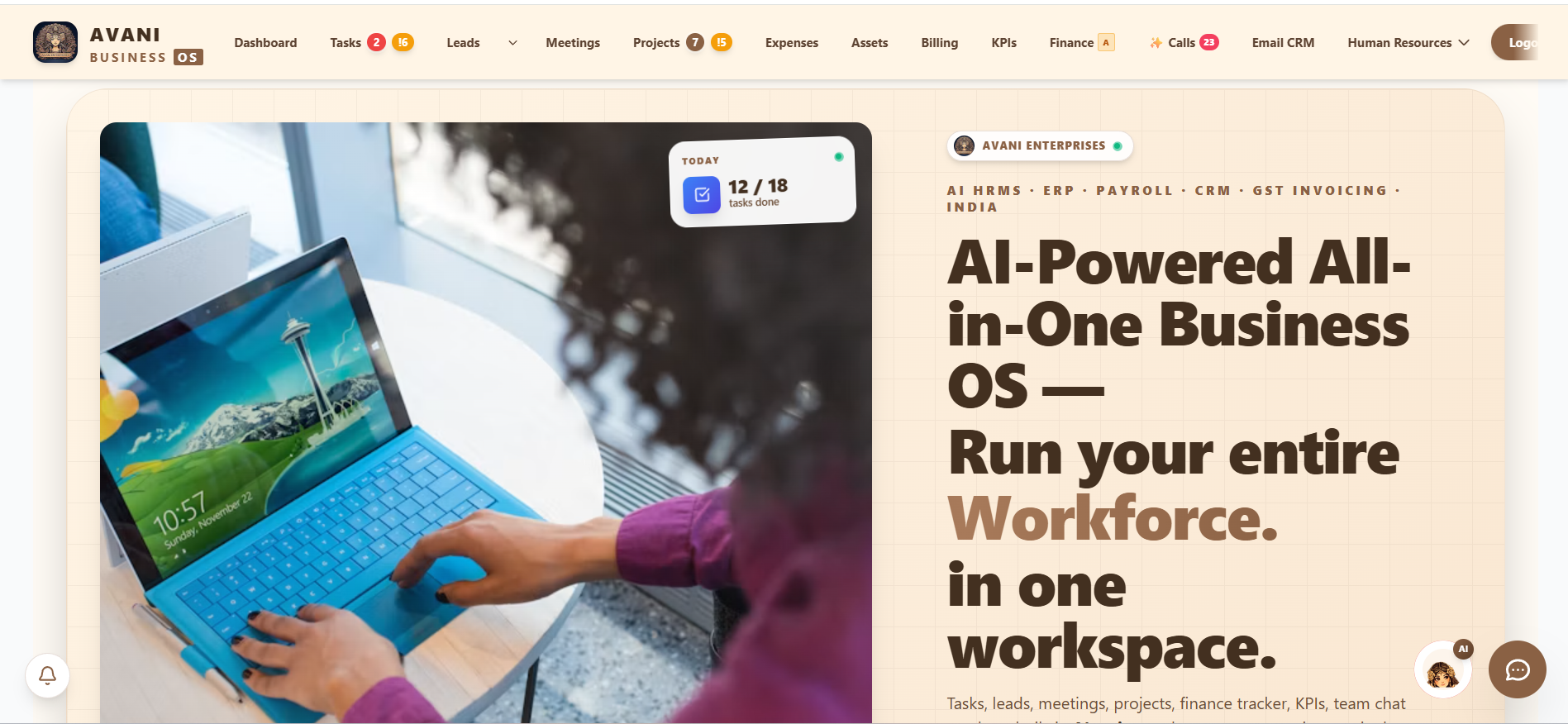
Most HR software automates the requests and leaves the arithmetic. Leave lives in the system, attendance lives in a device or a sheet, and payroll happens at month end in Excel because the exports never quite lined up.
Automation means removing the reconciliation, not adding another form.
The full workflow, automated end to end
Onboarding
A joiner's details, documents and access captured once, into the record every later stage reads — no re-keying into a second system.
Attendance
Check-in and check-out recorded against that same employee record, so the data payroll needs is already in the right shape.
Leave
Requests, approval chains and balances, with the balance updating from the same ledger payroll consults.
Payroll
Runs directly off attendance and leave, applying penalty and deduction rules encoded once rather than remembered monthly.
Salary slips
Generated and distributed automatically, with a history employees access themselves instead of emailing HR.
Performance
Goal tracking, daily EOD submissions and team performance rates on the same record.
Analytics
Attendance trends and performance dashboards on aggregation pipelines, so reporting stays fast as years of history accumulate.
Where the 20 hours actually were
Not in any single task — in the seam between them. The old month-end was: export attendance, export leaves, reconcile by hand, apply deductions, produce slips, distribute individually. Every month, for every employee, with a spreadsheet as the real system of record.
The change that mattered was not building a payroll screen. It was that payroll reads the same records leave and attendance write, so month-end became a calculation instead of a reconciliation.
Access control is the feature, not a setting
HR holds the most sensitive data most companies have: salaries, documents, performance notes. An employee sees their own record, a manager sees their team, HR sees the organisation.
Enforced in middleware rather than by hiding buttons. Changing an id in a URL has to fail at the API, because the interface is not a security boundary.
What it runs on
React.js, Node.js, Express.js and MongoDB, with role-based access control and scheduled jobs for the recurring parts — payroll cycles, reminders, digests.
Payroll rollups and analytics run as MongoDB aggregation pipelines. Computing them in application code is the usual reason an HR system that felt instant in year one takes seconds in year three.
What it costs
Avani Business OS is priced at ₹25 per employee per month. Custom modules, integrations and bespoke builds are quoted separately against the feature set.
Per employee — ₹25 per employee / month
The whole platform, priced on headcount rather than per module.
Custom build — Quoted on the feature set
For modules that do not exist yet, or a process no product models.
Common questions
What does a full HR automation system include?
Onboarding, attendance tracking, leave requests and approvals, automated payroll with penalty and deduction calculation, salary slip generation and distribution, employee goal tracking, team performance, and HR analytics dashboards — all reading from one employee record.
How much manual work does HR automation actually remove?
In the case of the HR suite inside Avani Business OS, more than 20 hours per week. The saving comes from payroll generating salary slips directly from attendance and leave data rather than from a spreadsheet reconciled by hand each month.
Can HR automation handle custom penalty and deduction rules?
Yes, and that is usually the reason to build rather than buy. Rules that live in someone's head get applied slightly differently each month; encoded once they are consistent, auditable and explainable to the employee who asks.
Does it integrate with existing attendance hardware or payroll providers?
Where they expose an API, yes. The real decision is whether payroll calculation should live in the system or with the provider, which depends on how unusual your rules are.