AI-enabled HR management, with the permission layer that makes it safe
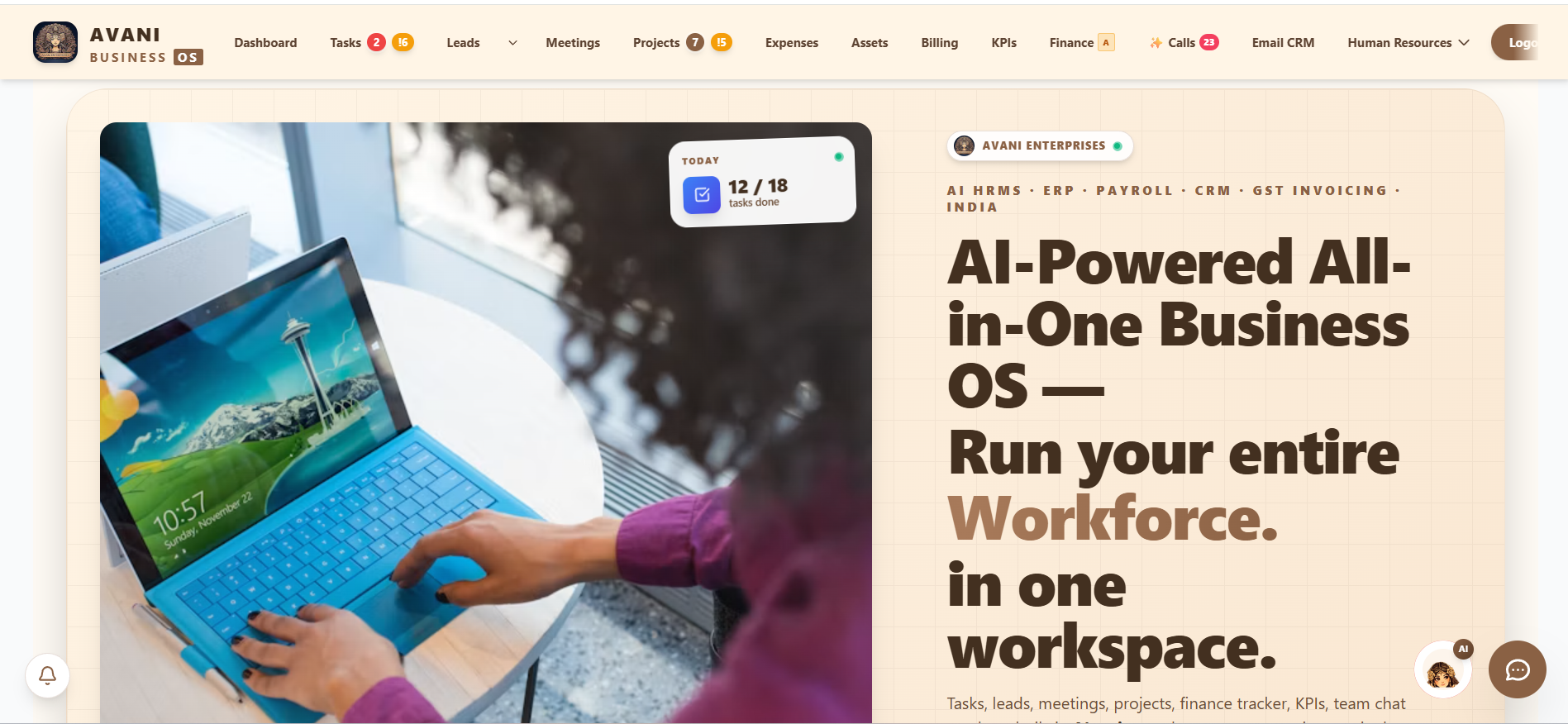
Soham Dang built the AI layer inside Avani Business OS: an OpenAI-based meeting assistant that transcribes live meetings and assigns action items over WhatsApp, plus MCP servers exposing HR, task, lead and finance data through a permission-checked tool layer.
AI in HR is the highest-stakes place to get the boundary wrong. The data is salaries, documents and performance notes, and an assistant that can answer questions about it can also answer the wrong person's question about it.
So the interesting engineering is not the model. It is the layer that decides what the model is allowed to see, before it sees it.
What the AI layer actually does
Meeting transcription to minutes
Live meetings transcribed, then turned into structured minutes rather than a wall of text — decisions and owners separated from discussion.
Action items assigned automatically
Tasks created from those minutes, assigned to owners and delivered over the WhatsApp Business API, which removes the follow-up step entirely.
An assistant over HR and business data
Questions answered across modules through MCP tools, scoped to what the asking user could already open themselves.
Bilingual input
Speech and read-aloud in English and Hindi via OpenAI APIs, which matters for an HR system used across a whole organisation rather than one department.
Why prompting is not a permission model
Instructing a model not to reveal another employee's salary is a request, not a boundary. Models are non-deterministic and prompt injection is a live technique, so a control that lives in the prompt can be argued out of it.
The boundary has to exist in code the model cannot influence. The model never gets database access — it gets tools, and each tool applies the same role and tenant checks as the equivalent API endpoint.
The rule in practice: if a user cannot open a record in the interface, the assistant cannot read it for them either.
The parts of HR that should not use a model
A useful share of what gets requested as AI is a workflow: notify a manager when a probation date approaches, flag attendance below a threshold, remind someone their timesheet is late.
Each is a trigger, a condition and an action. A rule costs nothing, runs in milliseconds, is testable and returns the same answer tomorrow. A model call costs money per invocation and does not.
Saying so is part of the job. The model belongs on the unstructured part — a meeting transcript, a free-text request — and ordinary code belongs on everything downstream of it.
Operational requirements
Scoped to the acting user
Every tool call carries the identity of the person the assistant is acting for, never a service account that can see everything.
Bounded results
Result sizes capped, because returning ten thousand rows into a context window helps nobody and costs real money.
Timeouts and rate limits
So a slow query cannot hang a conversation and a retry loop cannot call a tool fifty times.
Full audit logging
Every tool call, its arguments and its result. When someone asks why the assistant said something, that log is the only way to answer.
What it costs
Avani Business OS is priced at ₹25 per employee per month. Custom modules, integrations and bespoke builds are quoted separately against the feature set.
Per employee — ₹25 per employee / month
The whole platform, priced on headcount rather than per module.
Custom build — Quoted on the feature set
For modules that do not exist yet, or a process no product models.
Common questions
What AI features does the HR system have?
An OpenAI-based meeting assistant that transcribes live meetings, generates structured minutes and auto-creates action items assigned to owners over WhatsApp, plus an on-platform assistant that answers questions across HR and business modules through MCP tools.
How is employee data kept private from the AI?
The model never receives database access. It receives tools, and every tool applies the same role and tenant permission checks as the equivalent API endpoint, scoped to the user the assistant is acting for. If a user cannot open a record in the interface, the assistant cannot read it for them.
What is MCP and why does it matter for HR AI?
MCP (Model Context Protocol) exposes data and actions to a model as structured tools rather than raw access. That structure is what allows an authorisation layer to sit between the model and sensitive HR data, instead of relying on instructions in a prompt.
Does every HR AI feature need a language model?
No. Probation reminders, attendance thresholds and timesheet nudges are triggers and conditions — deterministic automation handles them more cheaply and predictably. Models belong on unstructured input such as meeting transcripts and free-text requests.
How much does it cost?
Avani Business OS is priced at ₹25 per employee / month — the whole platform, all 25+ modules, priced on headcount rather than per module. Custom modules, integrations and bespoke builds are quoted separately against the feature set.